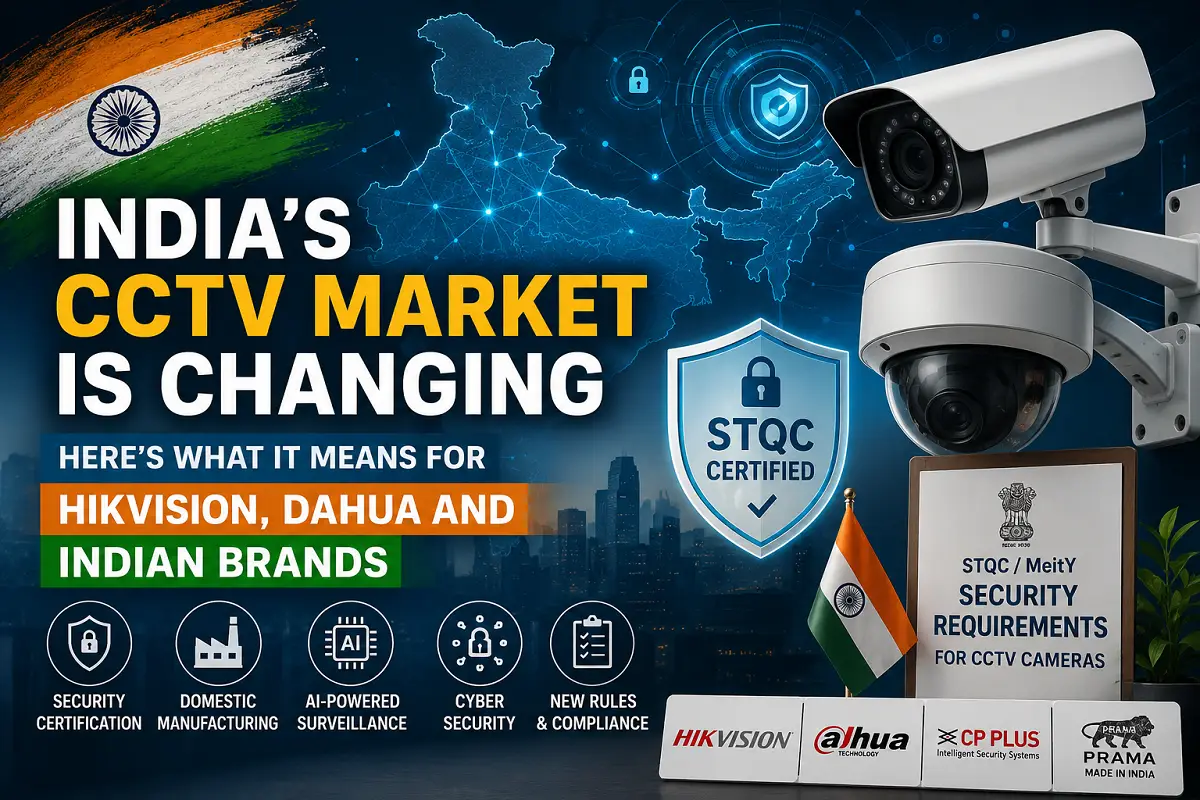
India’s CCTV industry is entering a new phase. Security certification, cybersecurity requirements, domestic manufacturing, and AI-powered surveillance are becoming just as important as megapixels, night vision, and price. Here’s what CCTV buyers, installers, and businesses need to know in 2026.
For years, buying a CCTV camera in India was relatively simple.
You compared the resolution, sensor size, night vision, storage capacity, warranty, and price. Installers usually had their preferred brands, while customers often chose between popular names such as Hikvision, Dahua, CP PLUS, and other established manufacturers.
But the CCTV market is changing.
A modern network camera is no longer simply a device that records video. It is a connected computing device that communicates over a network, may connect to cloud services, receives firmware updates, and can process sensitive video and user information.
That is why cybersecurity and product certification are becoming increasingly important in India’s surveillance industry.
The Government of India’s certification framework now specifically addresses security requirements for CCTV cameras. STQC, under the Ministry of Electronics and Information Technology (MeitY), operates an IoT System Certification Scheme that covers CCTV cameras and evaluates security-related aspects of connected devices.
At the same time, Indian manufacturers are increasing their focus on domestic production and locally developed security technology.
So, what does all of this mean for someone buying or installing CCTV cameras in India in 2026?
Let’s break it down.
What Is Changing in India’s CCTV Industry?
The biggest change is that CCTV security is increasingly being treated as both a cybersecurity and a physical security issue.
An IP camera can contain:
- A processor
- Firmware
- Network interfaces
- User accounts
- Passwords
- Storage
- Mobile applications
- Cloud connectivity
- Remote-access functionality
- Video analytics
- AI processing
This creates additional security risks that did not exist to the same extent with traditional analog cameras.
The Indian government has therefore introduced security-related requirements for CCTV cameras through the Public Procurement (Preference to Make in India) Order (PPP-MII) and the compulsory registration framework.
According to a February 4, 2026 MeitY circular, CCTV cameras were notified under PPP-MII for value-addition norms and security Essential Requirements. CCTV cameras were also brought under the Electronics and IT Goods (Requirements for Compulsory Registration) framework for compliance with security Essential Requirements, in addition to existing safety requirements.
This is a major shift in how CCTV products are evaluated.
What Is STQC and Why Does It Matter for CCTV?
STQC stands for the Standardisation Testing and Quality Certification Directorate under MeitY.
STQC operates the IoT System Certification Scheme (IoTSCS) for connected products and systems.
The scheme evaluates different parts of an IoT product, including sensing and embedded components, communication protocols, gateways, cloud components, end-user devices, and interfaces.
CCTV cameras are specifically included among the covered IoT product categories.
The certification framework considers security at multiple levels, including:
- Physical interfaces
- Communication interfaces
- Application interfaces
- Hardware security
- Software security
- Firmware update processes
- Protection against certain forms of attack
- Other security requirements depending on the assessment level
STQC describes three IoT security assessment levels, with higher levels providing more comprehensive security requirements. Level 1 represents a low assurance level, Level 2 provides additional protections and is recommended for most IoT devices containing sensitive data, while Level 3 is intended for more critical applications.
For CCTV, however, installers and buyers should pay particular attention to the specific certification or compliance status of the exact product/model, rather than assuming that an entire brand is automatically certified.

Is India Banning Hikvision and Dahua CCTV Cameras?
This is one of the biggest questions being asked in the Indian CCTV market.
The answer is more complicated than simply saying “yes” or “no.”
There have been media reports about restrictions affecting certain Chinese-origin surveillance equipment and about the government’s increasing emphasis on security certification and domestic sourcing.
However, buyers should be careful with headlines that say an entire CCTV brand has been “banned.”
A regulatory requirement applying to a product category, procurement process, certification or specific model is not automatically the same thing as a blanket ban on every product sold by a particular brand.
This distinction is extremely important.
The official STQC documentation currently provides specific certification and testing requirements for CCTV cameras. It also states that certificates previously issued under the IoT System Certification Scheme should not automatically be treated as valid for the CCTV PPO unless the products have been validated against the applicable Essential Requirements.
Therefore, installers should not make purchasing decisions based only on social-media posts or headlines claiming that a particular brand is completely banned.
Instead, check:
- The exact manufacturer
- The exact model number
- The applicable certification
- The product’s current compliance status
- Whether the project is subject to government procurement requirements
- Whether the camera is intended for a private, commercial, or government deployment
The model and compliance status matter.
What Does This Mean for Hikvision CCTV Users?
Hikvision remains one of the world’s best-known surveillance technology companies, and its products are widely used in many markets.
For an existing private CCTV installation, customers should not panic simply because they see a headline about new CCTV regulations.
If your Hikvision system is already installed and working, the correct response is not automatically to remove every camera.
Instead, consider:
- Where the system is installed
- Whether it is connected to the internet
- Whether remote access is enabled
- Whether the firmware is updated
- Whether strong passwords are being used
- Whether unused accounts have been removed
- Whether the NVR is exposed directly to the internet
- Whether the system is being used for a government procurement project
For new installations, particularly projects involving government departments or sensitive environments, compliance requirements should be checked before purchasing equipment.
What About Dahua CCTV Cameras?
The same principle applies to Dahua.
Dahua is another major international surveillance technology company with a large product portfolio covering:
- IP cameras
- NVRs
- DVRs
- PTZ cameras
- Access control
- Video management
- AI analytics
- Thermal imaging
- Professional surveillance solutions
But again, brand name alone should not be used as a substitute for checking the requirements of a particular project.
If a tender, government department, or regulated customer requires specific certification or security compliance, the installer should verify the exact products being proposed.
This is becoming increasingly important as surveillance systems become more connected.
Why Indian CCTV Brands Could Benefit
One of the most interesting developments in India’s CCTV industry is the increasing importance of domestic manufacturing.
Indian security companies have been investing in manufacturing, product development, and local support.
A prominent example is Prama India, which describes itself as an indigenous Indian CCTV and video-security brand and operates a manufacturing facility near Mumbai. The company says its product strategy includes indigenous manufacturing, R&D, and solutions designed for Indian requirements.
This does not automatically mean that every Indian CCTV product is better than an international product.
However, the shift toward local manufacturing creates several potential advantages:
1. Local Supply Chain
Domestic manufacturing can reduce dependence on imported finished products.
2. Local Technical Support
Indian manufacturers can potentially provide support that is more closely aligned with local installers and customers.
3. Government Procurement Opportunities
Domestic manufacturing and compliance can become particularly important in government and institutional projects where procurement rules apply.
4. India-Specific Product Development
Local companies can design products around Indian market requirements, environmental conditions, and installation practices.
5. Long-Term Industry Development
A stronger domestic security ecosystem can create opportunities for local R&D, component manufacturing, software development and skilled employment.
Prama Is Not the Only Indian Company to Watch
The Indian surveillance market is not limited to one manufacturer.
There are several Indian companies and brands working in video security, access control, networking and related electronic-security categories.
For example, STQC’s published records include certified network-camera products from Indian companies.
One STQC certificate lists network-camera products from Matrix Comsec, with the certificate covering specified models and stating compliance with the applicable security Essential Requirements.
STQC records also show certified network-camera product series from Indian vendors, including Samriddhi Automation.
This demonstrates an important point:
India’s surveillance industry is not simply moving from one brand to another. It is gradually developing a broader domestic ecosystem.

Does This Mean Indian CCTV Cameras Are Now Better?
Not necessarily.
This is where CCTV buyers need to be careful.
“Made in India” and “best CCTV camera” are not automatically the same thing.
A CCTV camera should still be evaluated on its actual specifications and performance.
For an installer, important factors include:
- Image sensor
- Lens quality
- Low-light performance
- IR performance
- Dynamic range
- Compression technology
- Bitrate control
- AI analytics
- False-alarm performance
- ONVIF compatibility
- NVR compatibility
- PoE support
- Firmware update policy
- Cybersecurity
- Mobile application
- Cloud functionality
- Warranty
- Technical support
- Spare availability
- Total cost of ownership
Certification and compliance are additional considerations—not replacements for technical evaluation.
The Biggest Change May Actually Be Cybersecurity
Many CCTV users still think security means protecting the camera from physical theft.
That’s only half of the problem.
Imagine a typical IP CCTV installation:
Camera → PoE Switch → Router → Internet → Mobile App
Every connection represents another potential security consideration.
If the camera has a weak password, outdated firmware, or unnecessary internet exposure, the CCTV system itself can become a security risk.
This is why installers should start treating CCTV deployments more like network infrastructure.
CCTV Installers Need to Think Beyond the Camera
In 2026, a professional CCTV installer should understand more than:
“Which camera gives the best picture?”
The better question is:
“Which complete surveillance system provides the right combination of image quality, reliability, cybersecurity, compliance, support and long-term value?”
That changes the installation process.
Before handing over an IP CCTV system, installers should consider:
Network Security
- Change default passwords
- Use strong administrator credentials
- Disable unnecessary services
- Avoid unnecessary port forwarding
- Use secure remote-access methods
- Segment surveillance networks where appropriate
Firmware
Check whether the manufacturer provides:
- Firmware updates
- Security patches
- Vulnerability notifications
- Product lifecycle information
User Management
Remove unnecessary accounts and give users only the permissions they actually need.
NVR Security
The NVR is just as important as the camera.
A secure camera connected to an insecure NVR does not create a secure system.
What Should You Check Before Buying CCTV in 2026?
Whether you’re a homeowner, shop owner, factory manager or CCTV installer, use this checklist before purchasing.
CCTV Buying Checklist
1. Check the exact model number
Don’t evaluate only the brand.
2. Check certification and compliance
If the project has regulatory or procurement requirements, verify the applicable certification.
3. Check the manufacturer
Understand who actually manufactures the product and where it is produced.
4. Check firmware support
A camera that receives no security updates can become a long-term liability.
5. Check NVR compatibility
Make sure the camera works correctly with the intended NVR/VMS.
6. Check cybersecurity features
Look for secure authentication, encryption, and controlled remote access.
7. Check warranty
A cheap camera is not cheap if replacement becomes difficult.
8. Check spare availability
This is particularly important for commercial installations.
9. Check AI features
Don’t assume that every “AI camera” has the same analytics capability.
10. Check total system cost
Include:
- Cameras
- NVR
- Hard disk
- PoE switch
- Cabling
- Rack
- UPS
- Installation
- Configuration
- Maintenance
What Should CCTV Installers Do Differently Now?
The installer community is likely to feel the impact of these changes more than ordinary consumers.
Earlier, customers often asked:
“Which camera is cheapest?”
Now, professional installers should be prepared to answer:
“Is this camera compliant?”
“Where is it manufactured?”
“Does it receive firmware updates?”
“Can it be securely accessed remotely?”
“Will it work with our existing NVR?”
“What happens if the manufacturer changes its product range?”
These are becoming important business questions.
For government, infrastructure, and enterprise projects, installers should maintain documentation for every major component.
Will Indian CCTV Brands Replace Hikvision and Dahua?
It is too early to say that one group of brands will completely replace another.
The more realistic scenario is that the Indian CCTV market becomes more diverse and more compliance-focused.
International manufacturers will continue to compete on:
- AI
- Image quality
- Product ecosystems
- Analytics
- Enterprise solutions
- R&D
Indian manufacturers can compete through:
- Local manufacturing
- Local support
- India-focused products
- Procurement eligibility
- Cost competitiveness
- Domestic R&D
- Faster local supply
The result could be a much more competitive Indian surveillance market.
The Future of CCTV in India Is About More Than Megapixels
For years, CCTV marketing was dominated by numbers:
2MP → 4MP → 5MP → 8MP → 12MP
But resolution is only one part of a surveillance system.
A 4MP camera with a good sensor, lens, WDR, and properly tuned night performance can sometimes produce more useful surveillance footage than a poorly implemented 8MP camera.
The next generation of CCTV will increasingly be judged by:
Image quality + AI + cybersecurity + reliability + compliance + integration
That is a much more meaningful way to evaluate surveillance technology.
What About AI CCTV?
AI is another major force changing the market.
Modern cameras can perform analytics such as:
- Human detection
- Vehicle detection
- Line crossing
- Intrusion detection
- Face-related analytics
- Object classification
- People counting
- License-plate recognition
- Unusual activity detection
But AI features vary significantly between manufacturers and product families.
A camera advertised as “AI” does not necessarily provide the same level of analytics as another AI camera.
Installers should therefore test the actual feature rather than relying only on marketing terminology.
A New Era for CCTV Buyers in India
The Indian CCTV market is moving toward a model where security, technology and compliance are becoming interconnected.
The government’s security requirements for CCTV, STQC’s certification framework, the growing emphasis on domestic manufacturing, and the rapid development of AI surveillance are all contributing to this transition.
For buyers, this means one thing:
Don’t choose a CCTV camera only because it has the highest megapixel count or the lowest price.
For installers, the message is even clearer:
Your job is no longer simply to install cameras. You are building a connected security system.
That means product selection, networking, cybersecurity, configuration, maintenance and compliance all matter.
And for Indian CCTV manufacturers, the next few years could be an important opportunity to prove that locally developed and manufactured surveillance technology can compete on quality, innovation, and reliability—not just price.
Frequently Asked Questions
Is CCTV certification required in India?
CCTV cameras are covered under India’s security-related certification and regulatory framework. The exact requirement depends on the applicable order, product category, and use case. STQC provides testing and certification mechanisms for CCTV under its IoT System Certification Scheme.
Is Hikvision completely banned in India?
A blanket statement that all Hikvision products are simply “banned” is misleading. Requirements can depend on the product, applicable certification, procurement rules, and deployment. Buyers should verify the exact model and the requirements applicable to their project.
Is Dahua banned in India?
The same caution applies to Dahua. Do not rely solely on a social-media claim or headline. Check the exact product, certification requirements and procurement conditions applicable to the installation.
Can I continue using my existing CCTV camera?
For private installations, a new regulatory announcement does not automatically mean that every existing camera must be removed. If you have concerns, check the specific requirement that applies to your installation.
Are Indian CCTV brands becoming more important?
Yes. Domestic manufacturing and local security technology are receiving increasing attention in India. Companies such as Prama India and Matrix Comsec demonstrate that Indian manufacturers are developing and producing video-security products for the domestic market.
Is a higher-megapixel CCTV camera always better?
No. Sensor quality, lens quality, low-light performance, WDR, compression, bitrate, and installation conditions can be just as important as resolution.
What should CCTV installers check before buying cameras?
Installers should check the exact model, technical specifications, NVR/VMS compatibility, certification requirements, cybersecurity features, firmware support, warranty, spare availability, and total cost of ownership.
What is the biggest CCTV trend in India in 2026?
One of the biggest trends is the convergence of video surveillance, AI, cybersecurity, and regulatory compliance. CCTV is increasingly becoming an intelligent networked security platform rather than simply a recording device.
Final Word
India’s CCTV industry is changing—and the change is bigger than one brand or one government notification.
The future of surveillance in India will likely be shaped by AI, cybersecurity, domestic manufacturing, certification, interoperability, and reliable after-sales support.
For CCTV buyers, the lesson is simple:
Don’t buy a camera only because it is cheap, popular or has more megapixels. Buy the complete security solution.
And for installers, 2026 is a good time to upgrade your approach.
The best CCTV installer of the future won’t simply know how to mount a camera and connect an RJ45 cable.
They will understand cameras, networks, cybersecurity, AI, storage, compliance, and the complete surveillance ecosystem.
That is where the Indian CCTV industry is heading.
Official References
- STQC – IoT System Certification Scheme
- STQC – CCTV Certification & Essential Requirements information
- STQC – Certified IoT Product List
- Prama India – Official Website
Latest Post
- CCTV Cameras Can Be Hacked: How to Secure Your CCTV in 2026
- India’s CCTV Market Is Changing—Here’s What It Means for Hikvision, Dahua and Indian Brands
- Guanlan Encoding by Hikvision – Features, Benefits & Complete Guide (2026)
- HikTech Star Show 2026 – Complete Guide, Benefits, Registration & Tips
- Plugins for Eco Series – Download, Install & Fix Plugin Issues