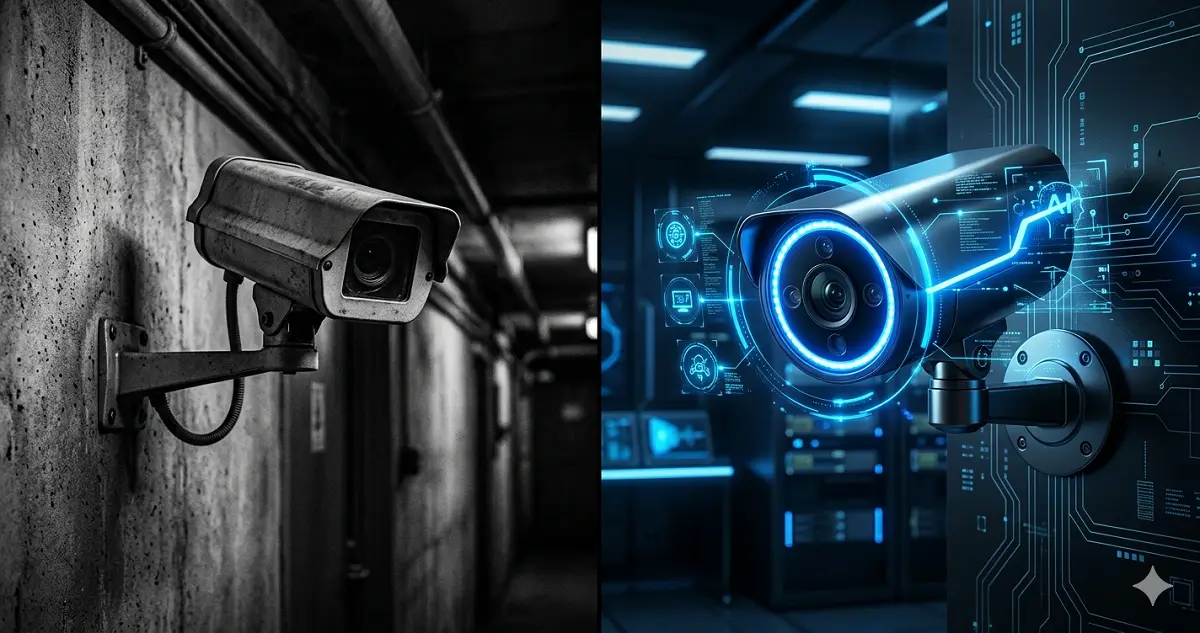
After installing hundreds of CCTV systems across homes, shops, warehouses, and schools, I can tell you this — the biggest mistake people still make in 2026 is buying the wrong type of camera. This guide will save you from that mistake. The topic is AI vs Normal CCTV.
If you’ve been shopping for CCTV cameras recently, you’ve probably seen two types of products side by side — regular CCTV cameras and AI-powered cameras. The price gap between them can be significant. So the question everyone asks me is: Is AI CCTV really worth it, or is it just marketing hype?
Let me break it down for you clearly, honestly, and practically — no jargon, no brand bias.
What is a Normal CCTV Camera?
A traditional CCTV camera does one job — it records video. That’s it. It captures footage, saves it to a DVR or NVR, and you watch it later when something goes wrong. The camera itself has no brain. It cannot tell the difference between a thief and a tree branch blowing in the wind.
Traditional systems use basic pixel-change detection to trigger motion alerts. Any movement — a passing vehicle, a street dog, heavy rain — can trigger a false alarm. Security teams or homeowners then have to manually review hours of footage to find the incident they actually care about. That is time-consuming, frustrating, and frankly ineffective.
“With a normal CCTV system, you’re essentially just creating an archive of evidence — AFTER the incident has already happened. You’re reactive, never proactive.”
What is an AI CCTV Camera?
An AI camera is not just a camera — it’s a camera with a brain. It uses deep learning algorithms and computer vision actually to understand what it’s seeing in real time. It knows the difference between a human, a vehicle, a dog, and a falling leaf. And it acts accordingly.
In 2026, AI cameras have become dramatically more capable. They can recognize faces, read license plates, detect loitering, identify abandoned objects, track individuals across multiple cameras automatically, and even flag suspicious behavior patterns — all without a single human watching the screen.

Head-to-Head Comparison: AI vs Normal CCTV
AI CCTV Camera
- Detects humans, vehicles & faces
- Real-time smart alerts
- Text-based footage search
- Auto-tracks intruders
- Triggers lights & sirens
- Reduces false alarms by 95%+
- Learns your environment
- Cloud + edge AI processing
Normal CCTV Camera
- Records video only
- Pixel-change motion alerts
- Manual footage search
- Static, no tracking
- No active deterrence
- High false alarm rate
- No learning capability
- Local DVR/NVR storage
Feature-by-Feature Breakdown: AI vs Normal CCTV
| Feature | Normal CCTV | AI CCTV |
|---|---|---|
| Motion Detection | Basic (pixel-based) | Smart (object-based) |
| False Alarm Rate | Very High | Very Low |
| Face Recognition | No | Yes |
| License Plate Reading | No | Yes |
| Auto Intruder Tracking | No | Yes |
| Active Deterrence | No | Siren + Strobe + Audio |
| Night Vision (Color) | Black & White | Full Color |
| Footage Search | Manual (hours of work) | Type a description |
| Installation Cost | Low | Medium–High |
| Monthly Cost | Zero | Some require subscription |
| Hacking Risk | Low (offline) | Medium (cloud-connected) |
The False Alarm Problem — Why It Matters
This is the single biggest reason people in 2026 are switching to AI cameras. With a traditional CCTV system, if you enable motion alerts, your phone will buzz 50 times a day — for dogs, bikes, insects flying in front of the lens, and headlights at night. You start ignoring alerts. And that’s when a real threat sneaks through unnoticed.
AI cameras changed this entirely. The system filters everything — it only alerts you when an actual human or vehicle is detected in a zone you’ve defined. It can even distinguish between a delivery person dropping a package and a stranger loitering suspiciously near your door.
Expert Insight
In my field experience, clients with traditional CCTV disable motion alerts within 2 weeks because of false alarms. That means they have zero protection. AI cameras are the only practical solution for real-time alerting.

Who Should Buy What?
🏠
Small Home / Flat
Basic indoor monitoring, Normal CCTV — OK
🏡
Large House / Villa
Outdoor + multiple entries AI CCTV — Recommended
🏪
Shop / Retail Store
Theft prevention, crowd analysis, and AI CCTV — Recommended
🏭
Warehouse / Factory
Safety compliance + perimeterAI CCTV — Strongly Recommended
🏫
School / Office
Access control, child safety, AI CCTV — Recommended
🚗
Parking Area / Gate
License plate reading needed AI CCTV — Recommended
What About the Cost?
This is where people hesitate — and I understand why. A good AI camera can cost 2x to 3x more than a standard CCTV camera. But let me give you the complete picture.
A traditional CCTV setup requires someone to physically monitor the screens, or you’ll miss incidents in real time. That means either paying for security staff or just having a passive recording system that helps only after a crime has happened. AI cameras eliminate the need for constant human monitoring. For businesses, this translates directly into reduced manpower costs and faster incident response.
Additionally, the latest generation of AI cameras in 2026 has dropped significantly in price. Entry-level AI cameras with person detection now start at prices competitive with mid-range traditional cameras. The gap is closing fast.
The 2026 Game-Changers in AI CCTV
1. Text-Based Footage Search
You can now type “man in red shirt near gate at 9 pm,” and the AI will pull up the exact clips — instantly. What used to take hours now takes seconds. This is a revolution for investigations and incident management.
2. Active Deterrence
The best AI cameras in 2026 don’t just record crime — they stop it. When an intruder is detected, the camera can automatically trigger a loud siren, flash strobe lights, and issue a voice warning. Many criminals flee before any damage is done.
3. Behavioral Analysis
Advanced AI systems can now distinguish between a delivery driver dropping a package and someone loitering suspiciously. They can detect if someone is climbing a fence, if an abandoned bag has been left behind, or if there’s a crowd forming suddenly — and alert you immediately.
4. No Subscription Fees (New in 2026)
This is huge. For years, AI camera features like cloud storage and smart detection were locked behind monthly subscriptions costing ₹300–₹800 per camera. In 2026, many top brands will now offer full AI processing directly on the device (edge AI) with local storage and zero monthly fees.
Final Verdict
So — AI or Normal CCTV in 2026?
Here is my honest recommendation after 10+ years in this industry:
Choose AI CCTV if…
You have a shop, office, large home, warehouse, or any outdoor area that needs real-time protection. Budget allows mid-range investment. You want smart alerts, not just recordings.
Choose Normal CCTV if…
You’re on a very tight budget. You need indoor monitoring only for basic record-keeping. You already have an existing analog DVR setup and just want extra cameras.
The truth is, normal CCTV in 2026 is becoming obsolete for any serious security need. AI is no longer a premium luxury. It’s fast becoming the standard. If you’re investing in a new system today, I strongly recommend going with AI, even at the entry level.
Security is not just about recording what went wrong. It’s about stopping things from going wrong in the first place. And that’s exactly what AI CCTV does.
Have questions about which CCTV system is right for your home or business? Drop a comment below or contact us directly at BestCCTVSolution.com. We’re here to help you make the right choice.
Latest Post
- CCTV Cameras Can Be Hacked: How to Secure Your CCTV in 2026
- India’s CCTV Market Is Changing—Here’s What It Means for Hikvision, Dahua and Indian Brands
- Guanlan Encoding by Hikvision – Features, Benefits & Complete Guide (2026)
- HikTech Star Show 2026 – Complete Guide, Benefits, Registration & Tips
- Plugins for Eco Series – Download, Install & Fix Plugin Issues